When World War II began in 1938 with Germany’s occupation of Czechoslovakia, few in what would become the Allied nations anticipated the global conflict it would soon become. As the war expanded, the Axis powers—Germany, Italy, and Japan—held the strategic advantage across much of the world by 1942. That year, however, brought major turning points that forced the Axis nations to make critical decisions, ultimately setting them on the path to defeat. All three powers faced serious challenges to their earlier dominance, though Italy—the weakest member of the alliance—began encountering setbacks even earlier, particularly in Africa in 1941.
Italy’s military fortunes in North Africa began to decline in 1941. In January, British and Australian forces captured Tobruk in Libya, dealing a significant blow to the Italian army. Around the same time, Italian forces in Eritrea suffered defeats and began to retreat. In February, the British pushed the Italians back even farther after a hard‑fought victory at the Battle of Keren. By May, Emperor Haile Selassie had returned to Addis Ababa, reclaiming Ethiopia’s capital. By the end of 1940 and throughout much of 1941, the Italian army experienced repeated setbacks on multiple fronts.
The Greeks were easily repulsing the Italian invasion of Albania, and the British succeeded in defeating the Italians in numerous battles in Libya.[1] These defeats, regardless of the fact that the Italians also achieved some victories over the British, forced the Germans to bolster the war in Africa by sending assistance to the Italians in the form of a Luftwaffe formation, an armored corps, and one of its best generals, Erwin Rommel.[2] These moves drew resources that the Germans needed in Russia and on the western front and set the stage for the eventual strategic challenges in 1942. Italy, however, already elected to support their German ally regardless of the fact they were not militarily able to do so, nor were they economically able to increase their forces, being barely able to replace their losses.[3] The Italians had made their decision, however, and they remained committed to Germany and to their African campaign into 1942. The commitment to Africa, it could be argued, began the demise of Germany’s hold on Europe, for they expended resources that would have found better use against the Soviet Union.
The arrival of the additional German forces, and more importantly, Rommel, shifted the balance in Africa in the Axis powers’ favor. In April and May of 1941, the German forces moved into Egypt, pushing the British out in the process. Mid to late 1941, however, would include two instrumental mistakes by the Axis powers, although at the time, they portended their growing power. In June 1941, the Germans invaded the Soviet Union, and in December 1941, the Japanese attacked the United States. These two events would eventually spell disaster for the Axis war effort, and it began in 1942 for all three of the belligerent powers. The Germans were committed in Africa by this time, and while they had reversed the ill fortunes of the Italians, the British were not defeated, and the Americans were now in the war.
Germany was thus at a crossroads. Since the war began, Germany had achieved one victory after another, yet in December 1941, they were defeated outside of Moscow, the British held on in Africa, and the allies still remained active in the Mediterranean. Thus, Germany faced a variety of options on how to proceed. One option would have been to consolidate their gains and dare the allies to attack, but the combined economic might of the allies, particularly with the entry of the United States into the conflict, made this option impractical. The war might be prolonged, but the combined might that the allies would be able to bring against Germany would have crushed them eventually, particularly as the Germans and Japanese never devised a coordinated attack against their enemies.
Germany faced three strategic options for continuing the war: secure the Mediterranean to protect supply lines to its forces in North Africa; defeat the British in North Africa and seize the Middle East to eliminate the southern front; or concentrate fully on destroying the Soviet Union and stabilizing the eastern front. In the last scenario, Germany would have benefited greatly from persuading Japan to open a second front against the Soviet Union in the Far East, forcing the Red Army to divide its strength. Germany failed to pursue this opportunity.
Instead, German leaders attempted to pursue two of the three strategies simultaneously while neglecting the most critical one. By dividing their efforts, they left the decisive option unaddressed—and it was this failure that ultimately ensured their defeat.
Germany’s first possible course of action was to concentrate on eliminating all Allied forces in the Mediterranean. By early 1941, the Eastern Front had stalled: both German and Soviet armies were exhausted, and the spring thaw turned roads into deep mud, slowing operations to a crawl.[4] With the fighting in the east temporarily bogged down, Germany had an opportunity to redirect its attention southward and secure the Mediterranean theater.
Focusing on the Mediterranean would have meant:
- Driving the British out of North Africa
- Securing the Suez Canal and cutting Britain’s vital imperial supply routes
- Stabilizing the southern flank before resuming major operations elsewhere
Had Germany chosen this option decisively, it might have ensured reliable supply lines to its forces in Africa and prevented the British from using the region as a base for future counteroffensives. Instead, the Mediterranean remained contested, and the Axis never fully controlled the region. In Africa, General Erwin Rommel had achieved great success against the British and pushed them back to Egypt.[5] German forces were exhausted, however, and lacked adequate supplies to move against the strong British defensive positions in Egypt.[6]
The supply problem stemmed from the fact that the Germans and Italians as yet did not control the Mediterranean Ocean and its environs. This would become a larger issue in November 1942 when the allies landed in Algiers and Morocco in Operation Torch. The British and American landing forced the Germans to send massive reinforcements into Tunisia in order to halt the Allied advance.[7] These forces needed to be supplied, but British aircraft on Malta made this a hazardous affair at best.[8] If Germany had eliminated Malta and secured the Mediterranean in early 1942, it could have then provided adequate supplies to their forces in North Africa. German Leader Adolf Hitler, however, decided against an attack on Malta and instead agreed with Rommel’s suggestion of attacking Egypt, but the German forces were in no condition for such an attack.[9]
Due to the failure to control the sea lanes of the Mediterranean, German forces in North Africa possessed inadequate supplies to finish the defeat of the British army. The failure to eliminate the British presence in Africa blocked the path to the Middle East. Defeat of the British could have been carried out had Germany first secured the Mediterranean supply routes, which Germany could have accomplished had they captured Malta. Likewise, Tobruk remained in Allied hands, and this also posed a threat to German supply routes.[10]
The Germans attempted to take Tobruk in April 1941 but were defeated in the endeavor. An indication of the critical supply situation of the Germans became evident when German prisoners captured at Tobruk stated that they were short of both food and water.[11] Winston Churchill later stated that during the summer of 1941, Rommel was effectively neutralized due to the British presence at Tobruk, which was preventing communication with Germany and restricting the flow of supplies.[12] These issues, left unresolved in 1941, would play a crucial role in 1942.
Tobruk remained a key strategic position, and Germany was determined to take the fortress. Germany launched another assault on Tobruk in June 1942, and this time, Rommel was victorious. The German assault began at 0530 on the morning of 20 June 1942; by 0800 the next morning, some thirty thousand British soldiers surrendered.[13] This would be the high point for the Axis forces in 1942; the remainder of the year witnessed the gradual decline of their fortunes and the growing power of the Allies.
Even in late June, following the fall of Tobruk, had Germany eliminated Malta, they could have brought enough force against the British in Egypt to defeat them before November 1942, and this would have certainly altered Allied plans to launch Operation Torch. Once these two areas were secure, Germany could have turned to the Soviet Union with additional forces and a secure southern front. This they failed to do, and the decision to strike at the British in Egypt instead of taking Malta would have long-term effects.
The original plan of the Germans and Italians was to strike at Malta after Tobruk fell. General Rommel, however, had other plans. The assault against Malta was long in the planning, and it was something that the Italians desperately wanted. During the German attack against Tobruk, the Italians asked the Germans for fuel to conduct an attack against Malta, and the Malta operation became more important in their eyes following a small reinforcement of the garrison on the island, which enabled the British defenders to again make life difficult for the Axis supply convoys.[14] Hitler was disinclined to the attack and easily became persuaded by Rommel’s argument to continue to pursue the retreating British 8th army into Egypt, thus the attack never occurred.[15]
While Germany chose to ignore Malta and conduct operations in North Africa, it also continued to engage the Soviets, seeking victory in the east. Germany launched its summer offensive, Operation Blau, on 28 June 1942. Initially, the attack caught the Soviet Union by surprise, and the Germans enjoyed early victories.[16] The plan, however, was far too aggressive an,d like Barbarossa, sought to achieve too much with too little force.[17] In the end, the Battle of Kursk and the Battle of Stalingrad would bleed the Germans white, and they would never defeat the Soviet Union.
The Germans faced three major strategic choices in 1942, and it was in deciding which path to take that they doomed their overall strategy. Forgoing an attack on Malta ended up creating lasting repercussions for the German military. Without subduing Malta, Germany left the way open for the British to disrupt their supply convoys to Africa, which in turn seriously impacted the German ability to defeat the enemy, particularly after the Torch landings in late 1942. Their ally and the third leg of the Axis Triad, Japan, made similar missteps in Asia and the Pacific.
The growing Japanese Empire was on sound footing in late 1941. Japan’s confidence led it to make an aggressive move against the one power they felt could eventually defeat them, the United States. Thus, the Japanese government elected to conduct a surprise attack on the Americans at Pearl Harbor, Wake Island, and the Philippines in December 1941, and this brought the United States openly into the war. Likewise, the entry of the Americans immediately added the other allied nations to Japan’s list of enemies. This would add to the complications facing the Japanese in 1942, but the year began well for them, and they had the Americans, Australians, British, Chinese, and Dutch reeling in the Pacific and Asia.
The Japanese began 1942 with a full-scale invasion of the Philippines in January; the islands fell in April of the same year when the Americans evacuated Bataan. In February, the British stronghold at Singapore capitulated after just a week of resistance; some eighty thousand allied soldiers became prisoners of the Japanese. Following the fall of the British stronghold, President Franklin Roosevelt wrote to Prime Minister Winston Churchill the following words, “but no matter how serious our setbacks have been – and I do not for a moment underrate them – we must constantly look forward to the next moves that need to be made to hit the enemy.”[18] These words would be prophetic, but before the Allies could begin their moves against the Japanese, more setbacks occurred.
In March 1942, the Japanese followed up the taking of Singapore by forcing the Dutch East Indies to surrender. In April of that year, the last Americans holding out in the Philippines in the Bataan Peninsula surrendered as well. The year began with numerous victories for the Japanese, as it did for the Italians and Germans, but in May the tide began to turn against Japan.
On 8 May 1942, the United States Navy fought the Imperial Japanese Navy to a draw in the Battle of the Coral Sea. The Japanese were then repulsed in their attempt to capture Midway Island from the Americans in June. At this point, Japan faced its strategic crossroads. The Japanese could either remain on an aggressive footing and continue to attack allied positions, go on a defensive footing and consolidate their already significant gains to maintain their new empire, or they could conduct a strategic defense.
Following their defeat at the Battle of Midway, Japan opted to go with the third option and enacted a policy of strategic defense.[19] This option entailed maintaining their imperial gains while also continuing a slow advance against allied positions in New Guinea and the Solomon Islands.[20] The idea being that instead of fighting on all fronts, they would marshal their resources for defense and limited offenses. This plan, however, was based on overly optimistic ideas and poor intelligence.
Part of Japan’s decision to conduct a strategic defense was that their intelligence estimated the United States could not conduct any offensive operations until they acquired their new carriers and battleships in 1943.[21] Likewise, Japanese intelligence failed to understand the threat American submarines posed to their shipping; this was mainly because the Japanese primarily used their submarines to attack American warships and thus did not fully realize the threat to shipping that this weapon could pose.[22] Some Japanese leaders also failed to grasp America’s economic ability, which allowed the Americans to quickly replace losses.[23]
The Japanese also suffered from overconfidence in a similar way to the Germans. The Japanese elected to move troops from the Southern Pacific to China because they felt that the Allies were in no position to launch a major counterattack.[24] This would prove a fatal mistake, for the Americans were indeed prepared to begin their counteroffensive in 1942, and they did so in August at the island of Guadalcanal. Likewise, the Allies continued to conduct limited-scale operations against the Japanese. These operations chipped away at the enemy defenses across the strategic defensive line, and the attrition, particularly in the Japanese Air Force, would later pay dividends for the allies.[25] The American landing at Guadalcanal, however, would eventually amount to the first major offensive victory against the Japanese.
The Americans landed at Guadalcanal on 7 August 1942, and the struggle for the island lasted for five months. While the battle for Guadalcanal pitted the opposing forces against one another in a long, drawn-out campaign, both sides also had to contend with the terrain. The thick jungle environment limited movement to one to two miles a day and seriously impacted line of sight and overall visibility.[26] Insects such as giant ants, spiders, leeches, and mosquitoes, which carried malaria, and the continual dampness of the jungle brought on sickness that caused greater casualties than combat.[27] In the end, however, the Americans emerged from the battle as victors, and it would be the beginning of the end for the Japanese Empire.
The Japanese had entered the conflict confident and powerful. This overconfidence also led to a feeling of superiority and an underestimation of the enemy forces. Likewise, the Japanese were not as powerful as they first appeared, and losses in combat became harder and harder to replace. This was particularly true of experienced combat pilots, a factor that seriously hampered Japanese efforts later in the war. Prior to their defeat at Guadalcanal, however, the Japanese enjoyed victories that added to their early overconfidence, particularly in China and South Asia.
The Japanese knew that the Chinese possessed a large army, but they viewed that army as poorly trained and equipped and therefore, not a major threat.[28] Likewise, easy Japanese victories against the allies in the China-Burma-India Theater bolstered their view of being able to hold against allied attacks. This overconfidence led to Japan not realizing the threat to its defensive system. The allies conducted a three-theater attack on Japan, limited in scope until 1944, but deadly. The Allied strategy of attacking in the China-Burma-India Theater, from Australia up through the Philippines, and across the Pacific Ocean, cost the Japanese dearly in men and supplies.[29]
Japan’s policy of strategic defense made sense, but its serious lack of intelligence and underestimation of the enemy facing them made that defense untenable. In hindsight, one can see little the Japanese could have done to improve the situation. They faced determined enemies who would settle for nothing short of total victory. The Japanese surprise attack on Pearl Harbor hardened the American resolve against them, and their treatment of allied prisoners of war and the Chinese civilians under their domain ensured that only a total surrender by Japan would suffice. Even with their enemies resolved against them, Japan did have one path that might have aided their cause.
The key element that might have made the Japanese defense stronger would have been to allocate more resources to intelligence and counterintelligence. They lacked knowledge of the Allies’ capabilities, and they lacked the understanding that the Allies were continually breaking Japanese codes. Even in mid-1942, when the Japanese finally began changing their codes on a more regular basis, the Allies responded by devoting more resources to breaking the new codes.[30]
The allies actively studied and collected information on Japanese signals. Both sides engaged in radio traffic analysis, which provided valuable information even when the signals could not be read. This method was used to determine the location and strength of enemy forces.[31] Japan’s quick rise to Empire status from 1937 to 1942 placed a strain on its ability to maintain secrecy. The Japanese forces were simply so widespread that they began to have difficulty in getting new cipher and code books to their forces, which made many Japanese garrisons reliant on using old codes the Allies already knew.[32] In short, it seems unlikely that anything the Japanese did would have altered the factthat they were simply spread too thin, over too wide an area, and that they did not possess the resources to support their defense. This became particularly true once the full might of the American industrial machine came into play.
The Axis powers began the war using speed, aggressiveness, and surprise. From 1937 to 1942, they held the upper hand as the war gradually expanded from the Japanese invasion of Manchuria into a global war for dominance. The year 1942, however, witnessed a change in the fortunes of Germany, Italy, and Japan. The Germans failed to manage the African theater and the Mediterranean Theater before overextending themselves in the invasion of the Soviet Union. The Italians were incapable of subduing the British in Africa, and thus, Germany expended valuable resources in a failed attempt to maintain control in Northern Africa. Japan attempted to restrict its reach in the Pacific and Asia, but in provoking the United States, it created an enemy it could never hope to defeat with its limited resources.
The Axis powers experienced the peak of their power in 1942, and by the year’s end, they were beginning to see the decline of that power. From 1943 through the end of the war in 1945, the Allies continued a determined and calculated assault on the Axis forces. Italy would collapse first in 1943, and only Germany and Japan continued to fight into 1945, but they never coordinated their attacks or their strategy. How differently might the conflict have turned out had the Japanese opened a second front against the Soviet Union, forcing the Soviets to allocate resources away from the battle with Germany? The Soviet Union most likely would face defeat and the need to surrender; this, in turn, would have freed German forces for use against the Allies in Africa and a possible invasion of Great Britain. This was not the case, and in the end, overreach, overconfidence, lack of solid intelligence, and a lack of any coordinated strategy between the Axis powers ensured their eventual defeat.
Works Cited
Churchill, Winston. 1950. The Second World War, The Grand Alliance. Boston: Houghton Mifflin Company.
—. 1950. The Second World War, The Hinge of Fate. Boston: Houghton Mifflin Company.
Gilbert, Martin. 1989. The Second World War, A Complete History. New York: Henry Holt and Company, Inc.
Greene, Jack: Massignani, Alessandro. 1994. Rommel’s North Africa Campaign, September 1940-November 1942. Conshohocken: Combined Books, Inc.
Murray, Williamson, and Allan R. Millett. 2000. A War to be Won, Fighting the Second World War. Cambridge: Harvard University Press.
Spector, Ronald H. 1985. Eagle Against the Sun, The American War with Japan. New York: The Free Press.
Sulzberger, C.L. 1985. World War II. Boston: Houghton Mifflin Company.
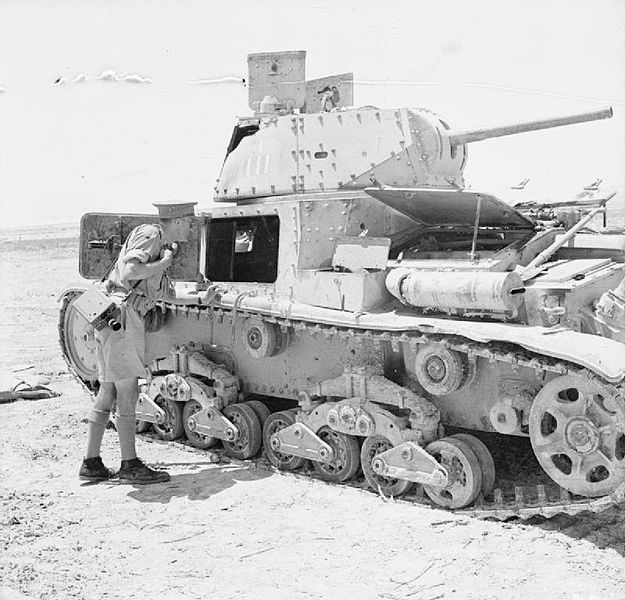
An AFPU cameraman inspects a knocked-out Italian M13/40 tank, 17 July 1942

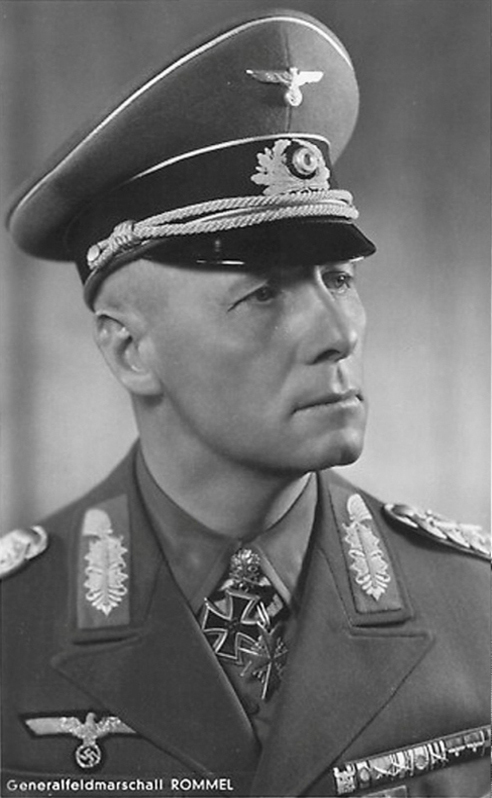
Erwin Rommel in 1942
By Bundesarchiv, Bild 146-1973-012-43 / Unknown / CC-BY-SA 3.0, CC BY-SA 3.0 de, https://commons.wikimedia.org/w/index.php?curid=5418950
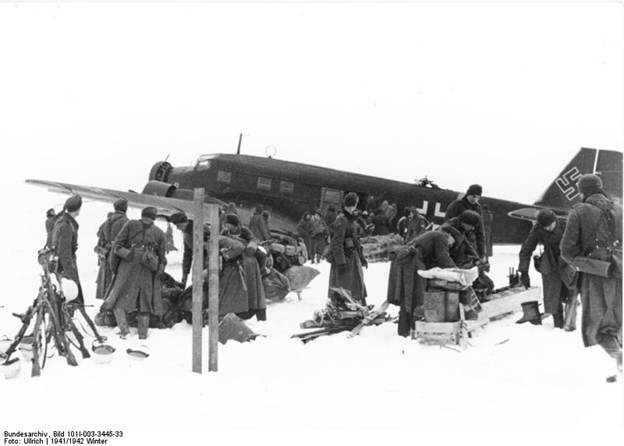
Russland, Lufttransport mit Junkers Ju 52
By Bundesarchiv, Bild 101I-003-3445-33 / Ullrich / CC-BY-SA 3.0, CC BY-SA 3.0 de, https://commons.wikimedia.org/w/index.php?curid=5408129
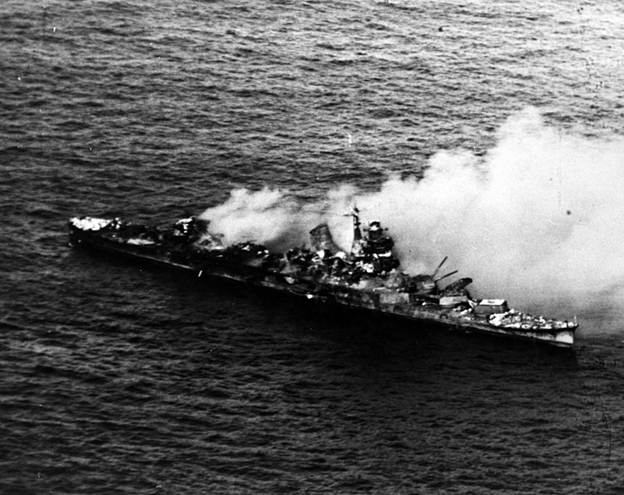
Battle of Midway, June 1942. The burning Japanese heavy cruiser Mikuma, photographed from a U.S. Navy aircraft during the afternoon of 6 June 1942, after she had been bombed by planes from USS Enterprise (CV-6) and USS Hornet (CV-8).
.jpg)
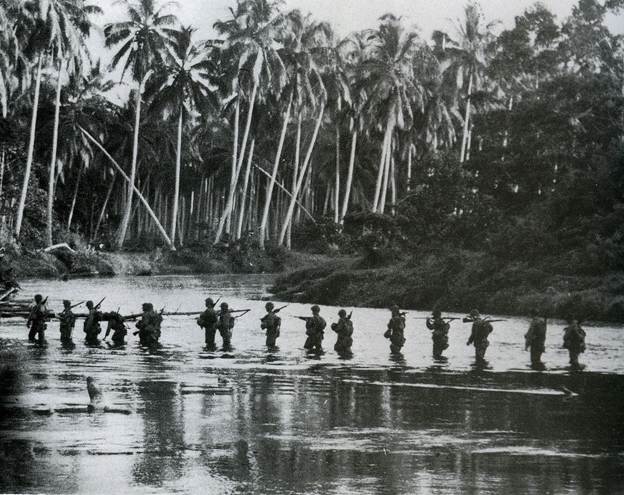
A U.S. Marine patrol crosses the Matanikau River on Guadalcanal in September 1942
By Unknown author – Frank, Richard B., Guadalcanal, the Definitive Account of the Landmark Battle, (1990), Penguin Group, ISBN 01401.65614, between pages 306 and 307 states that the source of the photo is the U.S. National Archives without providing additional author or date information., Public Domain, https://commons.wikimedia.org/w/index.php?curid=958513
[1] C.L. Sulzberger, World War II (Boston: Houghton Mifflin Company, 1985), 102.
[2] Ibid.
[3] Jack Greene and Alessandro Massignani, Rommel’s North Africa Campaign, September 1940-November 1942 (Conshohocken: Combined Books, Inc., 1994), 11-12, and 32.
[4] Williamson Murray and Allan R. Millett, A War to be Won, Fighting the Second World War (Cambridge: Harvard University Press, 2000), 273.
[5] Ibid., 263 and 266.
[6] Ibid.
[7] Ibid., 298.
[8] Ibid.
[9] Ibid., 270.
[10] Ibid., 266.
[11] Winston Churchill, The Second World War, The Grand Alliance (Boston: Houghton Mifflin Company, 1950), 210.
[12] Ibid., 401.
[13] Martin Gilbert, The Second World War, A Complete History (New York: Henry Holt and Company, Inc., 1989), 335.
[14] Greene and Alessandro Massignani, Rommel’s North Africa Campaign, 167.
[15] Ibid., 167-168.
[16] Murray and Millett, A War to be Won, 279.
[17] Ibid., 283.
[18] Winston Churchill, The Second World War, The Hinge of Fate (Boston: Houghton Mifflin Company, 1950), 107.
[19] Murray and Millett, A War to be Won, 196.
[20] Ibid., 197.
[21] Ibid., 196.
[22] Ibid., 226.
[23] Ibid., 233.
[24] Ibid., 197.
[25] Ibid., 232-233.
[26] Ronald H. Spector, Eagle Against the Sun, The American War with Japan (New York: The Free Press, 1985), 197.
[27] Ibid.
[28] Murray and Millett, A War to be Won, 196.
[29] Ibid., 227 and 232-233.
[30] Spector, Eagle Against the Sun, 454.
[31] Ibid., 446.
[32] Ibid., 450.


