The Seven Years’ War (1754-1763) began in North America in 1754 in the Ohio Valley and in Europe in 1756. The war was primarily a struggle between Great Britain and France, but numerous nations, particularly in Europe, joined the conflict. In North America, however, the war took a different aspect. The terrain, the presence of native peoples joining the conflict on both sides, and the different style of warfare all played a role. The style of war that the native tribes engaged is was very different from that of the European style of warfare. Humiliation, torture, and slavery were natural facets of the Indians style of combat, and these acts provoked equally harsh reprisals, particularly from the British colonists. This new way of war forced the British to alter their own method of war from a European to a North American style.
When the war concluded, however, it was not simply military issues between the British regulars and the American militia that undermined the relationship between the British and the colonists. Economic issues, in the form of taxation, further widened the gap that the cauldron of war created between the British and her American colonists. These economic measures stemmed in some degree from British dissatisfaction with the performance of the Americans. The British mainly fought alone in America, while the French had the Spanish as an ally in the region. The British did have the use of the American colonials, but in many instances, the colonials proved to be more of a hindrance than a help.
The British, and particularly the British regular military men and officers, did not view the Americans in a positive fashion. The Americans, for the most part, were civilians mustered into war, and in their use, the strain between regular soldiers and civilian soldiers became evident. The cauldron of war in North America during the Seven Years’ War brought soldiers, civilians, and native peoples together in a brutal and harsh environment that strained relations between all parties. This strain carried over after the war and left lasting animosity between the combatants. While tension and animosity certainly existed between the Europeans and the native Indians, it also existed between the British and the American colonists. While there are numerous reasons for the strain between the British and the colonials, the main factor that created friction between the two was in the conduct of the wars’ prosecution and its economic aftermath.
During the Seven Years’ War, the conflict in North America differed greatly from the one that raged in Europe. This was mainly due to the differences in terrain and the presence of various native tribes of Indians in America. Both the British and the French utilized the Indians as allies in the war, but the native style of warfare was very different from the European style. The hilly and heavily wooded terrain in North America made it ideal for woodland tactics, such as those long practiced by the Indian tribes, and difficult for standard linear European formations. While the French adopted these tactics relatively well, the British suffered numerous defeats at the hands of the French and their Indian allies early on in the war until they adapted.[1] An early example of the Indians style is evident in the account of Thomas Brown of Charleston, Massachusetts. Brown, a member of Major Robert Roger’s Rangers, recounted his ordeal in at the hands of Indians fighting with the French. Following a foray towards the French fort at Ticonderoga, the French and their Indian allies ambushed the Rangers as they attempted to return to Fort William Henry. Brown, who suffered three wounds in the fight, escaped with two other wounded men after the main British force retired.[2]
Brown recounts how as he lay with two other British wounded, the Indians arrived and while he attempted to crawl into the shadows to hide, he witnessed an Indian approach Captain Spikeman, strip him and scalp him alive.[3] Brown limped away, but the Indians captured him the following and took him prisoner, marching him back to the main French force. The French, after interrogating Brown, turned him over to the Indians who alternated showing him kindness in the form of food and clothing, to psychological abuse in the form of draping fresh scalps on him and attempting to kill him with tomahawks.[4] Brown eventually gained his freedom, but his ordeal, and the brutal acts he witnessed, such as the burning alive of a British prisoner by the Indians who thrust slivers of pine bark into the man’s skin and lit them until the anguish forced him to throw himself into a blazing fire, simply illustrate the different means of warfare the Europeans encountered in North America.[5] The torture and humiliation of prisoners was a normal course of action for the native tribes engaged in the war. The Europeans, unused to such acts, needed to adjust, and they did in due time.
The French adapted quicker than the British, but eventually, the British also learned to adapt, but in a different fashion. Where the French allowed and even seemed to condone the Indians methods, the British adapted and changed their forces to fit the environment without the inclusion of some of the native populations more extreme methods. These changes included altering from linear formations to lightly armed and highly mobile units, and the adoption of light infantry and ranger units recruited from the colonial population.[6] This was an early example of the British recognizing the value of the civilian population, many of whom were hunters and skilled with a rifle as well as with moving through the wooded terrain undetected. One such unit was the 60th Royal American Regiment, which was comprised of a mix of colonials, Irish and English, and combined the skills of woodland tactics with the standard highly disciplined tactics of the British Army.[7] The use of civilians as scouts, rangers and militia, however, created the seeds for the discontent that would eventually lead to rebellion in 1775. While the British adapted to this new style of warfare, they found their Indian allies to be quite different from themselves, much as they did the American colonials.
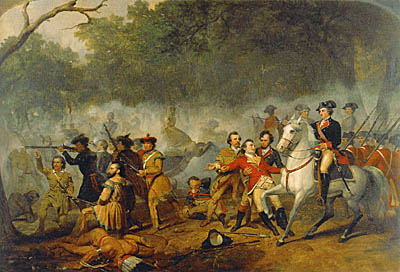
In one instance, George Washington experienced revulsion in Indian tactics following a brief skirmish with a French force. Washington’s Indian allies led him to a French camp, which the British then attacked early in the morning, easily defeating the French force with few casualties.[8] After the skirmish, Washington watched, but could do little, as the Indians attacked the French prisoners and killed the wounded French soldiers.[9] Washington did manage to protect twenty-one French prisoners and escort them away from the Indians, but these types of native tactics were something foreign to Washington.[10]
The French adapted far easier than the British did to the Indian style of warfare, and the result was early victories.[11] The situation, however, was not always congenial between the French and their Indian allies. There were times when after a battle, the Indians could not be controlled. One such was following the British surrender at Fort William Henry. The French had given honorable surrender terms, but the Indians did not fully comprehend this European custom for their way of war was different. The Indians not only failed to uphold the surrender terms, but as other Indians had done with earlier under Washington’s command, they began killing the wounded.[12] The French did little to stop this activity and there were even reports they taunted the British with what the Indians would do to them as they attempted to retreat.[13] While there are also reports the French officers attempting to protect British prisoners, like Washington, they had little control over the Indians.[14] These two brief examples highlight some of the differences in the Indian and European style of warfare.
The terrain and the differing styles of warfare forced the European powers to adapt their tactics and fighting style. Both sides adopted the use of light, mobile units in the wilderness, which utilized Indian warfare methods. This shift in military thinking came about from necessity. The early attempts at conducting warfare in North America using standard European tactics did not work in wilderness areas. This is pointedly described by Tanaghrisson, an Indian leader, who stated that George Washington had no experience, no skill at woodland warfare, and no idea how to work in concert with his Indian allies.[15] This would hold true until the Europeans learned the tactics of the new environment. The evolution, however, was not an easy one and the Europeans, particularly the British, experienced difficulty in dealing with the native tribes.
One of the primary causes of conflict between the British and the Indians was the long-standing animosity between Great Britain and France. The French controlled Canada and utilized trade and missionaries to incite conflict between the British and the Indians. One such case was French missionaries attempting to incite the Abenakis of Massachusetts to the warpath against the northern British colonies.[16] The French had used the Indians in previous colonial wars, such as King William’s War, Queen Anne’s War, and King George’s War, so the tactics was not new to them. The Indians, whom the French allowed to conduct warfare in their own way, were crucial to French efforts against the British.[17] While the use of Indians added to French strength, there were drawbacks. The French found it difficult to control the Indians at times, such as in the aftermath of their victory over the British at Fort William Henry. The Indian massacre of British prisoners and wounded only served to increase the negative British views on the native tribes and by using the Indians in this way, the British developed a distrust of the French and thus did not offer generous surrender terms in future engagements.[18] The British, however, also made mistakes, and not just with their Indian allies.
The American colonists desired land and much of the land the coveted was in what the British deemed Indian Territory. This fact did little dissuade the colonists, however, and they continually strove to gain additional land. The British seemed incapable of controlling the colonists push to acquire more territory. The colonists engaged in dishonest land deals with native tribes and frequently acquired more land than was agreed upon by rewording contracts.[19]
This aggressive attitude by the colonists eroded the Indians trust of the British and this fact, coupled with the British dislike of the Indians, made the situation worse. William Johnson, a British politician, voiced a typical contemporary view of the Indians when he stated that they were, “a bloodthirsty revengeful sett of people.”[20] Interestingly, Johnson also worked closely with Indian tribes in an attempt to get them to aid British war efforts. He led Mohawk Indians in the Battle of Lake George and was the superintendent of the Northern Indians.[21] This, of course, did not mean he did not have the European’s disdain for the Indians that many expressed, simply that they were a tool, a tool to be used in war against the French. The issue of land also concerned Canada.
The main issue of contention between the British Government and the various colonies concerning Canada was land expansion. The British certainly had the idea of taking France’s colonial possessions away from her, and thus obtaining the abundant natural resources Canada contained, but they also focused on establishing new colonies. The British were also desirous of preventing the American colonists from encroaching on any more Indian lands.[22] This did not coincide with the various British colonies ideas for Canada. The New England colonies, New York, and Pennsylvania were all seeking to expand trade with the Indians and to acquire additional land in which to expand their colonial territory. Canada had both land and a wealth of natural resources, something the French discovered early on in the settlement of North America.[23] While the British desired the same territory, especially to deny it to the French, the American colonies all had their own reasons for seeing Canada become British, which did not always center on land.
One thing all of the aforementioned colonies shared was a fear of French encroachment and Indian attacks along the frontier. The security of the frontier areas was always in question, and the French practice of motivating the Indians to attack British settlers in the hopes they would halt the expansion of the British colonies only made matters more serious.[24] By the time the Seven Years’ War broke out, the British colonies sat surrounded by the French and Spanish colonial possessions, and this not only threatened security, but also trade and expansion. [25] This latter element had been a factor since 1749 when French Captain Pierre-Joseph Céloron traveled the upper Ohio region re-establishing the French claim to the area and warning any British settlers he found along the way.[26] This was a direct encumbrance to Pennsylvania as much of the territory France claimed blocked westward expansion by the colony. The French presence also affected New York and its territory.
The French fortifications on Nova Scotia at Louisbourg and Cape Breton Island hindered the expansion of the New England colonies and the fortification at Crown Point on Lake Champlain blocked the New York frontier while the French presence in those places allowed for Indian excursions into the colonies. [27] Pennsylvania, New York, and the New England colonies wanted the French gone and felt that only the removal of France from Canada would guarantee their security.[28] This element of security would later directly influence events leading to the American Revolution. The New England colonies, and particularly Massachusetts, also had financial reason for wishing the French defeated in North America.
Massachusetts had certainly invested the most in the war effort financially, and they tended to view themselves as the protestant champions fighting the expansion of Catholicism in North America.[29] As a result of Massachusetts efforts in the conflict with France, they had some rather serious economic issues. The colony had provided a vast amount of men and money for the war thus far, and these efforts had left their ability to continue the struggle greatly reduced.[30] Because of their economic problems, Massachusetts experienced difficulty in continuing to raise men for military service. The British had to use a combination of threats and the promise of funds from Parliament in order to galvanize the colony to raise the required amount of men.[31]
Great Britain was seeking to destroy France’s commerce in an effort to gain it for themselves, and also to keep it from their enemy, thus hampering France’s ability to re-build her navy. Securing Canada would go a long way to accomplishing this goal. The colonies, however, were increasingly self-interested. They sought expansion into the Ohio Valley, protection from French backed Indians and the French themselves, and they desired trade opportunities. Removing the French from Canada would accomplish these goals. The self-interest is particularly evident in Pennsylvania’s desire to seize Pittsburg and the Ohio Valley not so much to keep the French out, but from allowing the colony of Virginia to take possession of either one.[32] These differences continued to strain relations between the British and the colonists.
Aside from the land and security issues, the conflicts between the British and the Americans stemmed in large measure to a difference in views on rights and discipline, a situation made worse by the Seven Years’ War and the colonists interaction with British commanders. The colonials who served under British commanders disliked the harsh discipline and rule of the British army.[33] They preferred serving under their own officers and in having any discipline meted out by their fellow colonials. The British use of flogging was particularly distasteful to the colonists. The colonial mindset, being of a freer nature, thought nothing of leaving military service once their term of service had expired. In one incident, the British commander at the time Lord Loudoun paid some three hundred sixty Massachusetts militia from his own funds to remain on duty garrisoning frontier forts.[34] The men stayed, but decided to leave service and go home once the term of the paid service was completed, and some of their officers agreed.[35] These elements exasperated the British and further widened the growing gap between the British and the colonials.
The British viewed the colonials as backward, lazy, and disloyal. The British also viewed the colonial soldiers as, “amateurish, hard to discipline, and deficient in technical experience.”[36] To this end, the British enforced regulations the colonists found insulting and degrading. One such measure was the British regulation that reduced colonial officers, even those of high rank, as subordinate to British officers of any rank.[37] This had the effect of making a colonial colonel subordinate to a British regular ensign, a very humiliating experience and one that sowed anger and resentment among the colonists. [38] The colonists, however, had ample reason to view British leadership in an ill light.
One campaign in particular demonstrates why the colonial soldiers reserved a low opinion of British military leadership. The Ticonderoga Campaign in 1758 witnessed just how vital leadership was to both British regulars and colonial militia. The campaign was entrusted to General George Augustus Howe, the eldest of three brothers all of served in the military forces of Great Britain. The commander of all British forces in North America was one General James Abercromby, whom King George II appointed as supreme commander in North America, and whom Howe served as deputy, but Howe remained in nominal command of the Ticonderoga Campaign, even after Abercromby arrived with the main portion of the British force.[39]
As the British began their advance, Howe led a group of ranger units and light infantry, commanded by General Thomas Gage, up an arm of Lake George attempting to get around to the rear of Fort Carillion on Lake Champlain.[40] Thick woods that quickly made command and control a serious problem marred the way, and after the British battle line dissolved in confusion, they ran into a French advance guard attempting to return to the fort.[41] One can only imaging the resulting skirmish as both sides engaged one another in thick woods, which seriously marred visibility. Howe, perhaps unwisely leading from the front, died with a French bullet in his chest in the opening moments of the skirmish, although the British routed the French force, they lost a man that was arguably their ablest commander in North America at the time.
Contemporary journals, such as that of colonial militiaman Rufus Putnam, give a glimpse at Howe’s level of respect amongst both Britons and colonials. In Putnam’s 6 July 1758 entry, he tells of the aforementioned skirmish and the death of Howe. Putnam wrote, “we lost but few men, but among them a brave and bold commander, that worthy man, my Lord Howe.”[42] Howe’s death created confusion amongst the British leadership and a significant drop in morale amongst the soldiers.[43] The result of this death was that the attack upon the French devolved into a campaign of poor judgment that ultimately led to failure when General Abercromby took over command of the British attack.
Abercromby’s leadership was both indecisive and flawed. The army of British regulars and colonials waited for orders, but when they came, they demonstrated the lack of military leadership needed to capture the French works. The British were about to conduct a siege of a fort, and the best weapon at their disposal was artillery, which the British had in abundance. Amongst the British equipment were sixteen cannon, eleven mortars, particularly useful to fire shells over the high walls of a fort, thirteen howitzers, and over eight thousand rounds of ammunition.[44] Likewise, the French, due to a lack of men and time, did not secure the nearby hill then called Rattlesnake Hill, later renamed Mount Defiance.[45] The hill, over seven hundred feet in height, would have afforded the British an excellent vantage point to reduce the fort using artillery, yet Abercromby elected not to do so, and here, his lack of military competence cost the British not only the battle, but numerous lives.
Disdaining the use of artillery, Abercromby ordered a frontal assault in a three deep line formation against the French defensive abatis.[46] Even after Abercromby order the attack, he failed to notice, or failed to care, that the French flanks were dangerously exposed and a determined assault would most likely have rolled up the French defensive line.[47] The British general, determined on a frontal assault, ordered his men forward, with no artillery support, or any real plan other than a direct assault against a strong defensive position.
The assault failed and casualties amongst the British and the colonists were high.[48] In his journal, Lemuel Lyon, a colonial soldier, stated that the engagement “began about 10 clock and held ten hours steady and we lost three thousand regulars.”[49] Rufus Putnam also commented on the carnage in his journal. Upon arriving at the field of battle, Putnam stated, “I was very much amazed to see so many of our men killed and wounded. The path all the way was full of wounded men.”[50] Putnam also noted that the artillery was heading in the opposite direction of the fort stating, “I was much amazed to see the floating batteries rowing back, the meaning of which I could not tell.”[51] The colonial soldiers, seeing this type of carnage, as well as understanding the non-utilization the artillery that was at hand, it is little wonder they began to question British military leadership. One could argue that these instances were the abnormality, not the normal state of affairs in the British army. The year 1759 would underscore this latter argument.
The British victory at the Battle of Quebec and the leadership of William Pitt were key elements to the British victory in the Seven Years War. The victory at Quebec came at a time when British arms were achieving success around the globe. The British captured the French island of Guadeloupe in June 1759, the Duke of Brunswick’s forces in Europe defeated the French at the Battle of Minden in August 1759, the Royal Navy defeated a French fleet off Portugal in the Bay of Lagos the same month, and the British captured Ticonderoga, Niagara, and Crown Point in North America in September 1759.[52] The British achieved these victories the same year that they defeated the French at Quebec, and achieved a crushing victory over another French fleet at the Battle of Quiberon Bay, in September and November respectively.[53] This series of victories came about as a direct result of the policies of William Pitt.
The policies of Pitt, however, were not new. They had long been the established Whig strategic policy.[54] What Pitt did that enabled the British to achieve such success in 1759 was to champion the continental policy in an effort to keep France occupied in Europe while the British attacked their possessions overseas. He supported a two hundred thousand pound subsidy to Hanover to pay for the Army of Observation, and favored increased ties with Prussia.[55] His goal was to keep Britain involved in European affairs, keep France occupied, strengthen the navy, and attack France’s overseas colonies, thus depriving the French of revenue and resources with which to prosecute the war.[56] To this end, the Battles of Quebec and Quiberon Bay proved decisive.
For the colonists in New England, New York, and Pennsylvania, news of the fall of Quebec brought rejoicing.[57] Likewise, the elimination of the French threat from Canada that the fall of Quebec seemed to represent brought a sense of security to the colonists.[58] The victory over the French fleet at Quiberon Bay added to this sense of security, for the French fleet was never again a threat in the war. The victory at Quiberon Bay secured the Atlantic for the British and prevented France from reinforcing its remaining armed forces in Canada, thus preserving Quebec and eventually delivering Canada to Great Britain.[59] These victories also emboldened Pitt and his war strategy. Prior to this series of military achievements, British arms had suffered a series of setbacks and Pitt was ready to give up the venture and sue for peace.[60] His combined strategy, however, ended up winning the war, thus British leadership in fact, prevailed.
The Battle of Quebec, however, was not as decisive as it seemed. The French survived and continued to control the colony for another year.[61] If the French had been able to reinforce the colony, they might have easily retaken Quebec and push the British back out of Canada. The victories at sea, and particularly that at Quiberon Bay, eliminated this possibility. The French had no means to break through the British fleet in order to resupply and support their forces in Canada, and this led the British to ultimate victory. The success of the British war strategy, however, did little to diminish the strain that developed between the American colonists and the mother country. As the war ended, another element would add to the growing discontent, money.
Perhaps the issue that played an immediate and long-term impact resulting from the Seven Years War was the issue of economics and specifically debt. This was particularly true in North America. Following the defeat of the French in North America, the loss of British military contracts and the shift in fighting to other theaters, created a vacuum for war materials and supplies in the American colonies. The shift from a war to a peace footing following the defeat of the French, and then dealing with various Indian uprisings, created disarray in the colonial governments.[62] Likewise, the economic depression that arose following the war affected merchants and traders in the colonies in a significant fashion. The British soldiers and sailors who spent disposable income in America were leaving, the military contracts were gone, and the exchange rates versus sterling began to rise.[63] These factors all contributed to the depression and the rise of significant debt issues amongst the colonists.
The debt issue was severe, affecting small and large merchants, crop growers, and tobacco growers alike. One such tobacco farmer that experienced the problems that arose from debt was George Washington. Washington was already experiencing financial difficulties from poor crops, sub-standard tobacco, and the costs of maintaining his plantation.[64] The depression following the war only made matters worse for him and many in his class. These issues would continue to plague many in America and greatly affected relations with the British, a fact that helped lead to revolution in 1775.
The colonists, however, were not the only ones affected by the poor economic situation. Great Britain’s war debt had risen to one hundred forty million pounds, with five million pounds per year interest.[65] While the per capita debt in the colonies was eighteen shillings, in Great Britain it was eighteen pounds.[66] This led to the passage of new taxation measures, widely supported in Great Britain and even by Benjamin Franklin, and these measures directly affected the colonists.[67]
With financial issues strangling the colonial economy, the introduction of new British taxes only exacerbated the situation. The growing debt situation was indeed significant. Years later, Thomas Jefferson remarked that, “the spirit of war and indebtment, which, since the modern theory of the perpetuation of debt, has drenched the earth with blood, and crushed its inhabitants under burthens ever accumulating.”[68] These accumulated burdens became one of the primary reason for colonial dissatisfaction that eventually led to the American Revolution that broke out in 1775, and by 1783, Great Britain had lost a large portion of the North American colonies she had held at the close of the Seven Years War.
The global nature of the Seven Years War resulted in Great Britain securing an empire with colonial possessions around the world. India, North America, and the Caribbean in particular became rich economic British possessions. While these colonies produced wealth for the empire, they also created a great expense in order to maintain their protection. The high costs of the war and the subsequent need to protect the various colonies prompted Great Britain to enact the aforementioned taxation measures.
One of the early measures was the Sugar Act, passed in 1764 in an effort to get the American colonies to help pay for some of the war costs and the continued stationing of British troops in the colonies for protection.[69] This act proved highly unpopular and the Americans viewed the measure as Great Britain reversing its policy of not taxing the colonies directly.[70] The Stamp Act followed the Sugar Act in 1764 and then the Quartering Act in 1765, both of these acts further incited discontent amongst the colonists.[71] Aside from the taxation measures, many colonists viewed the Seven Years War, which was the fourth in a series of wars for empire, as Great Britain expanding its empire at the expense of the colonists, who lost their lives fighting for the British, which disrupted their ability to work their farms and thus hampered the colonial economy.[72]
The Seven Years War gave Great Britain command of the seas and a powerful empire, but it also ignited the discontent of the American colonists and spelled doom for the native peoples. The numerous wars and subsequent taxation measures brought into focus the many differences of the colonists and the British. In the end, the lack of British response to the growing discontent, or to head the advice of former governors such as Thomas Pownall, who argued for fair treatment of the colonists as British subjects, were key elements that helped to bring about the American Revolution in 1775. [73] The cauldron of war that engulfed natives, Britons, French, Spanish, and the American colonists fractured multiple societies in North America. The French and Spanish lost their remaining North American possessions over the next few decades, the British would eventually lose the American colonies, and the native peoples now faced with a growing America no longer held in check by the European powers. This latter element would perhaps be the most significant fallout of the cauldron of war as the Americans pushed westward to the Pacific Ocean, and pushed the native peoples out of their way in the process.
Bibliography
Anderson, Fred. Crucible of War, The Seven Years’ War and the Fate of Empire in British North America. New York: Vintage Books, 2000.
Borneman, Walter R. The French and Indian War, Deciding the Fate of North America. New York: Harper Collins Publishers, 2006.
Brown, Thomas. “The Trials of a Ranger.” In Narratives of the French & Indian War , 11-23. Driffield : Leonaur Ltd., 2008.
Butler, Jon. Becoming America: The Revolution Before 1776. Cambridge: Harvard University Press, 2000.
Cook, Don. The Long Fuse, How England Lost the American Colonies, 1760-1785. New York: Atlantic Monthly Press, 1995.
Corbett, Julian S. England in the Seven Years War, A Study in Combined Strategy, Vol 1. London: Longmans, Green, and Co., 1907.
Jefferson, Thomas. Writings. New York: The Library of America, 1984.
Jennings, Francis. Empire of Fortune, Crowns, Colonies & Tribes in the Seven YEars War in America. New York: W.W Norton & Company, 1988.
Langguth, A.J. Patriots, The Men Who Started the Revolution. New York: Simon and Schuster, 1988.
Leckie, Robert. “A Few Acres of Snow”, The Saga of the French and Indian Wars. New York: John Wiley & Sons, Inc, 1999.
Lyon, Lemuel. “The Journal of Lemuel Lyon.” In Narratives of the French & Indian War: 2, 119-151. Driffield: Leonaur, Ltd, 2008.
Marston, Daniel. The Seven Years’ War. Oxford: Osprey Publishing Limited, 2001.
Pocock, Tom. Battle for Empire, The Very First World War 1756-1763. London: Caxton Publishing Group, 2002.
Putnam, Rufus. “The Journal of Rufus Putnam – Provincial Infantry.” In Narratives of the French & Indian War, 69-131. Driffield: Leonaur Ltd., 2008.
Simms, Brendan. Three Victories and a Defeat, The Rise and Fall of the First British Empire, 1714-1783. New York: Basic Books, 2009.
Steele, Ian K. Betrayals, Fort William Henry and the “Massacre”. New York: Oxford University Press, 1990.
[1] Daniel Marston, The Seven Years’ War (Oxford: Osprey Publishing Limited, 2001), 18.
[2] Thomas Brown, “The Trials of a Ranger”, (Driffield : Leonaur Ltd., 2008), 12.
[3] Ibid., 13.
[4] Brown, “The Trials of a Ranger”, 16.
[5] Ibid., 18.
[6] Ibid., 21.
[7] Ibid., 21-22.
[8] Fred Anderson, Crucible of War, The Seven Years’ War and the Fate of Empire in British North America (New York: Vintage Books, 2000), 6.
[9] Ibid.
[10] Ibid., 6-7.
[11] Ibid., 24.
[12] Ian K. Steele, Betrayals, Fort William Henry and the “Massacre” (New York: Oxford University Press, 1990), 111 and 115.
[13] Ibid., 117.
[14] Ibid., 119.
[15] Anderson, Crucible of War, 61.
[16] Robert Leckie, “A Few Acres of Snow”, The Saga of the French and Indian Wars (New York: John Wiley & Sons, Inc, 1999), 231.
[17] Anderson, Crucible of War, 151.
[18] Ibid., 199.
[19] Francis Jennings, Empire of Fortune, Crowns, Colonies & Tribes in the Seven YEars War in America (New York: W.W Norton & Company, 1988), 104.
[20] Ibid., 105.
[21] Anderson, Crucible of War, 131.
[22] Walter R. Borneman, The French and Indian War, Deciding the Fate of North America (New York: Harper Collins Publishers, 2006), 280.
[23] Leckie, “A Few Acres of Snow”, 87.
[24] Ibid., 292.
[25] Borneman, The French and Indian War, 12.
[26] Ibid., 15-16.
[27] Ibid.,8.
[28] Ibid., 6.
[29] Anderson, Crucible of War, 373 and 374.
[30] Ibid., 319.
[31] Ibid., 320.
[32] Ibid., 323 and 324.
[33] Ibid., 140 and 142.
[34] Ibid., 220.
[35] Ibid.
[36] Ibid., 140.
[37] Ibid., 140.
[38] Ibid.
[39] Borneman, The French and Indian War, 130.
[40] Ibid., 132.
[41] Ibid.
[42] Rufus Putnam, “The Journal of Rufus Putnam – Provincial Infantry”, (Driffield: Leonaur Ltd., 2008), 106.
[43] Tom Pocock, Battle for Empire, The Very First World War 1756-1763 (London: Caxton Publishing Group, 2002), 104-105.
[44] Anderson, Crucible of War, 242.
[45] Ibid.
[46] Ibid., 242-243.
[47] Borneman, The French and Indian War, 134.
[48] Pocock, Battle for Empire, 110-111.
[49] Lemuel Lyon, “The Journal of Lemuel Lyon”, (Driffield: Leonaur, Ltd, 2008), 133.
[50] Putnam, “The Journal of Rufus Putnam – Provincial Infantry”, 107-108.
[51] Ibid., 108.
[52] Brendan Simms, Three Victories and a Defeat, The Rise and Fall of the First British Empire, 1714-1783 (New York: Basic Books, 2009), 451-452.
[53] Ibid., 452.
[54] Ibid., 424.
[55] Ibid., 425.
[56] Ibid., 425-426.
[57]Anderson, Crucible of War, 373-374.
[58] Ibid., 375-376.
[59] Ibid., 395.
[60] Ibid., 377.
[61] Julian S. Corbett, England in the Seven Years War, A Study in Combined Strategy, Vol 1 (London: Longmans, Green, and Co., 1907), 475.
[62] Anderson, Crucible of War, 588.
[63] Ibid., 588-589.
[64] Ibid., 593.
[65] Don Cook, The Long Fuse, How England Lost the American Colonies, 1760-1785 (New York: Atlantic Monthly Press, 1995), 56.
[66] Ibid.
[67] Ibid., 56-57.
[68] Thomas Jefferson, Writings (New York: The Library of America, 1984), 1282.
[69] A.J. Langguth, Patriots, The Men Who Started the Revolution (New York: Simon and Schuster, 1988),48.
[70] Ibid., 49.
[71] Anderson, Crucible of War, 574 and 650-651.
[72] Jon Butler, Becoming America, The Revolution Before 1776 (Cambridge: Harvard University Press, 2000), 118-119.
[73] Ibid., 126-127.
 Historical Cogitations