The colonial victory in the American Revolution (1775-1783) stands as a lasting example of a colony rising up against an imperial power and securing its freedom. How much of the credit is due to American feat of arms and how much was a result of the numerous disadvantages Great Britain faced, however, is a matter of some debate. The British effort to subdue the rebellion in the American colonies lacked both an efficient wartime government such as William Pitt had run during the Seven Years’ War (1754-1763), and popular support at home for the war. A key disadvantageous factor to the British, however, was the involvement of other European powers, particularly France and Spain, in the conflict. The entry of France, and later Spain, elevated the American Revolution to a global war. Once France entered the conflict in 1778, Britain had to spread their resources around the globe to protect their empire. France and Spain also presented Great Britain with the challenge of facing two navies simultaneously. These factors greatly diminished Great Britain’s ability to prosecute the war in North America successfully. Likewise, the global threat to Great Britain’s empire caused a shift in strategic priorities. Foreign intervention not only placed Great Britain at a disadvantage, but also enabled the Americans to survive through difficult periods of the war. Many of the American military victories in the war would not have been possible without support from both France and Spain. The American colonists earned their victory in the American Revolution, but without the economic and military intervention of foreign powers, the British would have defeated the Americans.
Upon entering into war with the American colonies, Great Britain faced both political and military disadvantages. Politically, Prime Minister Lord Frederick North was simply unequal to the task of war leader. Lord North himself knew his own shortcomings and attempted to resign as Prime Minister on more than one occasion.[1] The lack of strong leadership compounded the always-present British concern over the balance of power in Europe.
Over the course of several decades, Great Britain and France had engaged in numerous wars, the most recent being the Seven Years’ War in which Great Britain had emerged as the dominant world power. France and Spain’s crushing defeat in this war would be a prime motivating factor for their support of the Americans during the revolution.
The French viewed the American colonies as the key to British power in Europe and desired to check the growing power of those colonies.[2] Many Britons, including James Abercromby, the Scottish colonial agent for North Carolina and Virginia, agreed that the North American colonies were the key to the balance of power in Europe.[3] Thus, the loss of Canada during the Seven Years’ War to the British was a serious setback to France both economically and politically. The loss of resources from Canada, coupled with the loss of part of her empire, affected France’s position in Europe. These factors, the numerous wars for empire, and the British rise in global power, created significant lingering animosity against Britain in Europe, particularly from France and Spain.
Since the end of the Seven Years’ War, Britain, France, and Spain had been engaged in a naval cold war that threatened to erupt into another full-scale conflict.[4] Added to this military threat, was an economic threat to the British economy when the British East India Company began to falter, forcing the British government to take over control of the company in 1773.[5] Faced with economic problems, a military threat to her naval supremacy, and ineffective leadership, Great Britain entered into the American Revolution with serious disadvantages. The Americans, however, also faced serious weaknesses at the wars outset.
The Americans began the war ill equipped to fight Great Britain. They did not maintain a well-trained army, they had almost no experienced military commanders, and the various colonies had demonstrated they did not cooperate well with one another.[6] Early in the war, the Americans suffered heavy defeats in Canada in 1776, which had lost them a sizable amount of their army and war material, and they learned that Great Britain was securing the rights to use German mercenaries in North America to put down the American rebellion.[7] The losses from the Canadian campaigns, coupled with the imminent arrival of additional enemy troops in the form of German mercenaries, placed the rebellion in serious jeopardy. Another disadvantage the colonials faced was the lack of money.
The paper script that the Continental Congress issued was worthless, so much so that counterfeit bills were easy to detect because they were of better quality.[8] This seriously affected the Americans, particularly the army. The rural farmers in Pennsylvania were selling beef and produce to the British for the main reason that the British paid in hard currency.[9] This left the Continental Army with an inadequate supply of food. The lack of currency, food, and war material had the rebellion is a serious situation. The Congress realized it had limited choices; it could reconcile with Britain, continue the fight with inadequate resources, or declare independence and gain foreign assistance.[10] They elected to take the latter course of action.
In the early part of the war, the Americans were wary of any alliances with Europeans. They had a particular distrust of France, whom they had helped Britain fight in earlier wars, and wished only for trade treaties in order to gain war material and money.[11] They would badly need the support of France to survive the early years of the war and in fact, prior to their formal entry as a belligerent in the American Revolution, France was supplying the Americans with significant aid. French economic and military assistance provided the Americans a means of continuing the war against Britain. This was a vital necessity to America as the British navy had severely damaged colonial shipping and thus devastated the maritime economy of the colonies.[12] Likewise, American battlefield defeats had weakened the Continental Army. Despite all of these setbacks to the Americans, and the introduction of German troops by the British, Great Britain was unable to end the rebellion in 1776. One reason for this was the flow of aid to the Americans from France and Spain, but the Americans would need more.
After the Continental Congress authorized Silas Dean to seek foreign aid, the Americans began to see the benefits of French assistance and not simply for supplies, but as a possible military ally against Great Britain.[13] In a letter to Count de Vergennes in December 1777, the American contingent in France asked for, “the Aid of Ships of War…to unite the Forces of the said States with those of France and Spain.”[14] Mainly with an interest in self-preservation, the American mindset had begun change in regards to an alliance with other nations, but France’s interest in American independence was also self-serving. France was a monarchy, and as such, they had little agreement with the principles that the Americans espoused for their independence. What motivated France was revenge. One reason France desired war with Great Britain was to exact retribution for French losses in the Seven Years’ War.[15] Another reason was that France was desirous of reducing Britain’s economic power while altering the balance of power in Europe by helping the Americans achieve independence, which would deprive Britain of some of her lucrative colonies.[16]
The event that finally brought France directly into the war against Great Britain, and thus made the war a global conflict, was the American victory at Saratoga in 1777. This victory was important in many ways, as it gave the Americans the victory they needed to assure France of their ability and it altered the course of the war by bringing France openly into the conflict in 1778. The victory, however, was not solely due to American military prowess; it was a result of French military aid. The French had supplied the vast amount of military supplies that the Americans used in the battle of Saratoga; without this French aid, the Americans would not have been able to fight, let alone win the battle. [17] The victory at Saratoga also unsettled the British Prime Minister.
The British defeat dismayed Lord North to such an extent that he authorized William Eden to contact the American delegation in Paris to seek peace with the Americans.[18] The Americans, however, had a strong ally and no longer needed to negotiate with Great Britain unless Britain granted the colonies full independence.[19] Aside from bolstering the American position, the French entry into the war added to Britain’s disadvantages in that the conflict in North America spread to include the Caribbean Sea, the Mediterranean Ocean, the Indian Ocean, India, and the British home waters. The alliance with France assured the Americans of a strong ally for the remainder of the war. In the Treaty of Alliance, Article VIII states, “Neither of the two parties shall conclude either truce or peace with Great Britain, without the formal consent of the other first obtained.”[20] Thus, with the formal entry of France into the conflict, Britain now faced a global war that would significantly stretch her resources.
France’s entry into the war helped the American cause, but Britain was still a powerful and dangerous enemy. Likewise, American finances were still an issue. In a letter written in October 1778, George Washington declared, “Can we carry on the War much longer? certainly NO, unless some measures can be devised, and speedily executed, to restore the credit of our Currency.”[21] Washington was also skeptical of an American victory with only France as an ally and without the combined might of the French and Spanish navies.
In commenting on an American victory without the navies of the Bourbon powers, Washington stated, “If the Spaniards would but join their Fleets to those of France, and commence hostilities, my doubts would all subside. Without it, I fear the British Navy has it too much in its power to counteract the Schemes of France.”[22] Here Washington is identifying that even with the French entry, American finances and military prospects were dim in the face of British power. Even the French knew that engaging the Royal Navy alone and without adequate preparation could spell absolute defeat for France.[23] The widening of the war into a global contest, however, did place a burden on British resources and thus greatly benefited the allies.
The expansion of the war forced a shift in British strategic thinking, as they needed to defend their various colonial possessions worldwide, and that lowered the importance they placed on the American war. This was most noticeable in the British electing to forgo subduing the northern and middle colonies and instead focusing on the southern colonies later in the war.[24] The British retained control of large cities, such as New York, but the military focus was the south. To this end, and with the assumption of strong loyalist support in the southern colonies, British General Sir Henry Clinton struck south and captured Charleston, South Carolina.[25] Clinton returned to New York and left General Charles Cornwallis in charge in the south to continue British efforts. Cornwallis quickly secured most of South Carolina and Georgia, but even with these victories, the British government clearly had shifted their military focus to other theaters of war, including defending their home waters.[26]
In just over two weeks after entering the war, the French navy engaged the British fleet in the English Channel near the island of Ushant in preparation for an invasion of Great Britain itself.[27] The battle was inconclusive, but the fact that the British Navy did not achieve victory in the engagement touched off a political battle for a scapegoat that undermined the British naval establishment.[28] The engagement also alerted Britain to the possibility of an invasion, and the need for a strong fleet in home waters.
In 1779, the threat of an invasion rose again when Spain entered the war on the allied side on 16 June of that year. The combined fleets of France and Spain outnumbered the British fleet in the channel and an invasion became a very real possibility.[29] The planned invasion, however, was convoluted and required three different French and Spanish fleets to sail from three different ports and rendezvous for an attack against Britain.[30] The intended target of the attack was Portsmouth, for the French believed taking the port would cripple the British economy and force them to seek peace.[31]
The Bourbon fleets, with a strength of sixty-six ships, entered the channel in July, but then accomplished little besides taking one British ship.[32] Sickness spread through the crews of the allied fleet, causing problems aboard the ships, and their inability to locate the British fleet left them effectively stranded off Plymouth.[33] While they could have taken the port at Plymouth, the aforementioned illnesses aboard ship, coupled with a gale that blew the ships off course, prevented the ports capture.[34] The spread of the sickness then reached epidemic proportions, and the allied fleets had to sail for home.[35] While the allies were unsuccessful in the invasion, their actions tied down British resources, which would affect the war in America and the Caribbean. This also caused the British to begin rethinking their war strategy, even while the British commander in North America, General Clinton, requested more troops.
General Clinton argued that to defeat the Americans he would need thirty thousand troops.[36] The French entry into the war, however, meant that those forces would not be available, as the British elected to use them elsewhere, in colonies they deemed more valuable. In fact, the British government ordered Clinton to abandon Philadelphia and to dispatch five thousand troops to bolster the British defenses in the Caribbean.[37] There was certainly a call for the British to be alarmed about the Caribbean theater. In 1779, the French had captured St. Vincent, Grenada, and Dominica.[38] These developments continued into 1781.
The French achieved early success in the Caribbean, capturing the above named islands and then adding Tobago, St. Kitts, Nevis, and Montserrat in 1781.[39] Then, a Spanish fleet utilizing some French ships blockaded Pensacola, Florida, and the British garrison surrendered on 9 May 1781.[40] The losses in the Caribbean, coupled with the need to maintain a fleet in home waters caused a further shift in British strategic thinking. The Royal Navy did have advantages over the Bourbon fleets. They could stay at sea longer, had better-armed ships, and the Admiralty employed a new strategy that focused on concentrating their sea power in the Caribbean.[41]
Following a series of small victories in late 1781 and early 1782, the British gained the upper hand in the Caribbean. In April 1782, the British navy achieved the final victory over the French in the Battle of the Saintes. In the course of the battle, the British crushed the French navy and secured the Caribbean, but they still faced serious problems elsewhere.[42]
The expansion of the war into a global conflict made the British view Canada and the Caribbean as more important than the American colonies. This was evident in Massachusetts governor Thomas Pownall’s comments in 1782 when he stated, “…The possession of the provinces in Quebec and Nova Scotia, is necessary to Great Britain so long as she retains her plantations in the islands of the West Indies.”[43] Canada was vital to British interests for the supplies of lumber, fish, and livestock, which the British in turn utilized to maintain the West Indies colonies.[44] Pownall stressed the importance of the Canadian colonies by stating, “The possession of these provinces is necessary to Great Britain as a naval power: without them, she can have no naval station, command, or protection in the American seas.”[45] The British contended that by maintaining control of Canada and the West Indies, they protected their empire and maintained a presence in the Americas, even if they did lose the American colonies. The importance of the supplies from Canada, particularly naval stores was evident after the aforementioned Battle of the Saintes in 1782. After the battle, the British Admiral Sir George Rodney stated that. “The great supply of naval stores lately arrived in the West Indies, will…soon repair all the damages.”[46] Success in the Caribbean came after a shift in British strategy, but that shift lost them the American colonies.
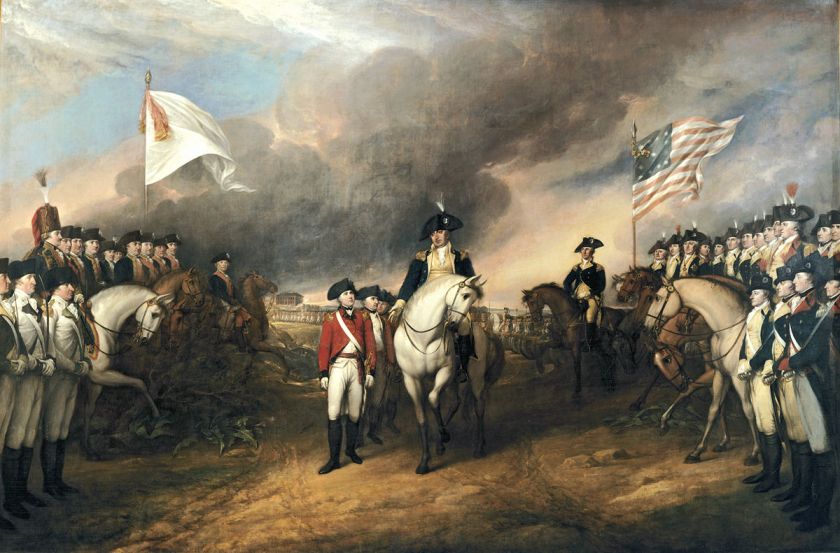
The American victory at Yorktown in October 1781, the final blow to British aspirations to achieve victory in the colonies, came because of an improved American army, French aid, and the aforementioned dispersion of British power across the globe. The support of foreign powers was crucial because the American army was not equipped to remain in the field and defeat a British army without assistance.[47] The French fleet, combined with the American army, trapped Cornwallis at Yorktown and forced his surrender. While it was not the final battle of the war, it ended any hope of a British victory in the American colonies. The disadvantages that Great Britain faced at the beginning of the war multiplied as foreign powers joined the fight against them, and these disadvantages, coupled with poor leadership, lost Britain her American colonies.
The Americans achieved a resounding victory over the British in the American Revolution and secured their independence. The intervention of foreign powers, however, provided the economic and military means that allowed the Americans to remain in the war. Without that foreign aid, they would certainly have lost the war. Commenting on France’s entry into the conflict, Thomas Jefferson said in 1778, “If there could have been a doubt before as to the event of the war it is now totally removed by the interposition of France.”[48] Thus was the entry of foreign powers viewed at the time by the rebellious Americans.
The expansion of the war from a North American conflict to a world conflict added greatly to the disadvantages facing Great Britain. The British reduced the available force they could bring to bear against the Americans because they needed to spread their military around the globe by necessity to defend their empire. The British did in fact maintain the majority of their empire, and defeated the French and Spanish navies in the process, but at a cost of the thirteen colonies.
Aside from the British strategic shift, the economic and military support provided by France and later Spain allowed the Americans to supply and pay their army. Without this support from the Bourbon powers, the Americans would never have survived 1776. From a failure to understand and negotiate with the Americans to alienating most of Europe and allowing the war to spread, Britain doomed itself to defeat in the American colonies. The fact that Britain held on to most of her possessions is a credit to her military, and had the political leadership matched, the war may have turned out differently. If the British had quickly mobilized overwhelming force and defeated the rebellion, or prevented France and Spain from entering the conflict through an early military victory or via political moves, they would certainly have achieved success. The failure to do either of these things added to the disadvantages Britain faced prior to the war and allowed the rebellious thirteen American colonies to gain their independence.
Bibliography
Cook, Don. The Long Fuse, How England Lost the American Colonies, 1760-1785. New York: Atlantic Monthly Press, 1995.
Draper, Theodore. A Strugle for Power, The American Revolution. New York: Random House, Inc, 1996.
Ferling, John. A Leap in the Dark, The Struggle to Create the American Republic. Oxford: Oxford University Press, 2003.
—. Almost a Miracle, The American Victory in the War of Independence. Oxford: Oxford University Press, 2007.
Fowler, Jr., William M. American Crisis, George Washington and the Dangerous Two Years After Yorktown, 1781-1783. New York: Walker & Company, 2011.
Franklin, Benjamin, Silas Deane and Arthur Lee. “American Diplomats Press for a French Alliance, 1777.” Brown, Richard D. Major Problems in the Era of the American Revolution 1760-1791. Lexington: D.C. Heath and Company, 1992. 201-202.
Gerard, Conrad Alexander, et al. “Treaty of Alliance, Eventual and Defensive.” Brown, Richard D. Major Problems in the Era of the Revolution 1760-1791. Lexington: D.C. Heath and Company, 1992. 205-207.
Hibbert, Christopher. Redcoats and Rebels, The American Revolution Through British Eyes. New York: W.W. Norton & Company, 1990.
Jefferson, Thomas. Writings. New York: The Library of America, 1984.
Langguth, A.J. Patriots, The Men Who Started the Revolution. New York: Simon and Schuster, 1988.
O’Shaughnessy, Andrew Jackson. The Men Who Lost America, British Leadership, the American Revolution, and the Fate of the Empire. New Haven: Yale University Press, 2013.
Pownall, Thomas. “Thomas Pownall on the importance of retaining Canada, 1782.” Horn, D.B. and Mary Ransome. English Historical Documents 1714-1783. New York: Oxford University Press, 1969. 792-793.
Rodney, Sir George. “Letter from Admiral Rodney to to Philip Stevens, Secretary to the Admiralty, describing the battle of the Saintes.” Horn, D.B. and Mary Ransome. English Historic Documents 1714-1783. New York: Oxford Univesity Press, 1969. 897-898.
Simms, Brendan. Three Victories and a Defeat, The Rise and Fall of the First British Empire, 1714-1783. New York: Basic Books, 2009.
Tuchman, Barbara W. The First Salute. New York: Alfred A. Knopf, 1988.
Washington, George. Writings. New York: The Library of America, 1997.
Willis, Sam. The Struggle for Sea Power, A Naval History of the American Revolution. New York: W.W. Norton & Company, 2015.
[1] Andrew Jackson O’Shaughnessy, The Men Who Lost America, British Leadership, the American Revolution, and the Fate of the Empire (New Haven: Yale University Press, 2013), 30 and 31.
[2] Theodore Draper, A Strugle for Power, The American Revolution (New York: Random House, Inc, 1996), 83.
[3] Ibid., 84-85.
[4] Brendan Simms, Three Victories and a Defeat, The Rise and Fall of the First British Empire, 1714-1783 (New York: Basic Books, 2009), 580.
[5] Ibid.
[6] John Ferling, A Leap in the Dark, The Struggle to Create the American Republic (Oxford: Oxford University Press, 2003), 117.
[7] Ibid.
[8] A.J. Langguth, Patriots, The Men Who Started the Revolution (New York: Simon and Schuster, 1988), 467-468.
[9] Ibid., 467.
[10] John Ferling, Almost a Miracle, The American Victory in the War of Independence (Oxford: Oxford University Press, 2007), 117-118.
[11] Ibid., 117.
[12] Simms, Three Victories and a Defeat, The Rise and Fall of the First British Empire, 1714-1783, 600.
[13] Ibid.
[14] Benjamin Franklin, et al., “American Diplomats Press for a French Alliance, 1777,” (Lexington: D.C. Heath and Company, 1992), 201.
[15] Barbara W. Tuchman, The First Salute (New York: Alfred A. Knopf, 1988), 143.
[16] Ferling, A Leap in the Dark, The Struggle to Create the American Republic, 203.
[17] Ibid.
[18] Don Cook, The Long Fuse, How England Lost the American Colonies, 1760-1785 (New York: Atlantic Monthly Press, 1995), 283.
[19] Ibid., 285.
[20] Conrad Alexander Gerard, “Treaty of Alliance, Eventual and Defensive,” (Lexington: D.C. Heath and Company, 1992), 206.
[21] George Washington, Writings (New York: The Library of America, 1997), 326.
[22] Ibid., 326-327.
[23] Sam Willis, The Struggle for Sea Power, A Naval History of the American Revolution (New York: W.W. Norton & Company, 2015), 198.
[24] William M. Fowler, Jr., American Crisis, George Washington and the Dangerous Two Years After Yorktown, 1781-1783 (New York: Walker & Company, 2011), 3.
[25] Ibid.
[26] Fowler, American Crisis, George Washington and the Dangerous Two Years After Yorktown, 1781-1783, 3-4.
[27] Tuchman, The First Salute, 144.
[28] Ibid., 145-146.
[29] Willis, The Struggle for Sea Power, A Naval History of the American Revolution, 285.
[30] Ibid., 284-285.
[31] Ibid., 287.
[32] Christopher Hibbert, Redcoats and Rebels, The American Revolution Through British Eyes (New York: W.W. Norton & Company, 1990), 259.
[33] Willis, The Struggle for Sea Power, A Naval History of the American Revolution, 290.
[34] Hibbert, Redcoats and Rebels, The American Revolution Through British Eyes, 259.
[35] Willis, The Struggle for Sea Power, A Naval History of the American Revolution, 291.
[36] O’Shaughnessy, The Men Who Lost America, British Leadership, the American Revolution, and the Fate of the Empire, 213.
[37] Ibid.
[38] Cook, The Long Fuse, How England Lost the American Colonies, 1760-1785, 318.
[39] Willis, The Struggle for Sea Power, A Naval History of the American Revolution, 444.
[40] Ibid.
[41] Willis, The Struggle for Sea Power, A Naval History of the American Revolution, 465.
[42] O’Shaughnessy, The Men Who Lost America, British Leadership, the American Revolution, and the Fate of the Empire, 315.
[43] Thomas Pownall, “Thomas Pownall on the importance of retaining Canada, 1782,” (New York: Oxford University Press, 1969), 792
[44] Ibid.
[45] Ibid.
[46] Sir George Rodney, “Letter from Admiral Rodney to to Philip Stevens, Secretary to the Admiralty, describing the battle of the Saintes,” (New York: Oxford University Press, 1969), 897.
[47] Tuchman, The First Salute, 244.
[48] Thomas Jefferson, Writings (New York: The Library of America), 1984), 760.
.
 Historical Cogitations